
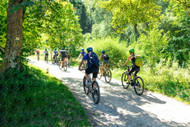
What Is Group Ride Cycling? Your Complete Guide to Riding With the Pack
Posted by 1UP USA on Jan 21st 2026

What Is Group Ride Cycling? Your Complete Guide to Riding With the Pack
Solo rides are great, but there's a reason cyclists keep coming back to group rides week after week. The camaraderie, the shared effort, the way miles seem to disappear when you're riding with others; It's a different experience.
However, if you've never joined a group ride before, the whole concept can feel a little intimidating. What exactly happens on these rides? How do you find one? And what are the expectations before showing up for the first time?
This guide covers everything you need to know about group ride cycling, from the basics of how it works to the unwritten rules that keep everyone safe and having fun.
Understanding Group Ride Cycling
A group ride is exactly what it sounds like: multiple cyclists riding together along a planned route. But there's more to it than just showing up and pedaling. Group rides operate with their own etiquette, structure, and communication systems that help large groups of riders move safely through traffic and terrain.
Most group rides are organized by a local bike shop, cycling club, or informal cycling group. They typically meet at a set location on a regular basis (Saturday morning rides are especially popular), follow a predetermined route, and maintain a target average speed.
The size of a group ride can vary dramatically. A small group might include just four or five friends, while popular club rides can attract 50 or more cyclists. Some rides split into smaller groups based on pace, so a faster rider and a more casual cyclist can both participate in the same event without anyone feeling left behind or held back.
Types of Group Rides
Not all group rides are created equal. Understanding the different formats helps you find rides that match your fitness level and goals.
Ride Type | Pace | Who It's For | What to Expect |
No-Drop Ride | Adjusts to the slowest rider | Beginners, social riders | Group waits at climbs, regroups regularly |
Drop Ride | Fixed average speed | Experienced riders, stronger riders | Maintain pace or find your own way back |
Training Ride | Structured intervals | Competitive cyclists | Hill repeats, speed work, specific goals |
Fun Ride | Conversational | Anyone seeking community | Coffee stops, scenic routes, relaxed pace |
No-Drop Rides
A no-drop ride is exactly what it sounds like: no one gets left behind. The group waits at the top of climbs, regroups at intersections, and adjusts the pace so every rider can keep up. These rides are perfect for beginners, riders returning after time off, or anyone who wants a social, low-pressure experience.
If it's your first group ride, a no-drop ride is an excellent place to start.
Drop Rides
A drop ride operates differently. The group maintains a target average speed, and riders who can't keep up are expected to find their own way back. These rides tend to attract more experienced riders looking to push their pace.
Drop rides aren't unfriendly; They're simply designed for people who want a workout. If you get dropped, it's nothing personal. It just means that particular ride wasn't the right fit for your current fitness level.
Training Rides
Some cycling groups organize structured training rides with specific goals: hill repeats, interval work, or endurance-building mile rides. These rides often attract competitive cyclists preparing for races or events.
Social and Fun Rides
On the opposite end of the spectrum, many groups organize casual fun rides focused on camaraderie rather than speed. These might include stops at coffee shops, scenic viewpoints, or breweries. The pace stays conversational, and the emphasis is on enjoying time with friends on bikes.
How to Find Group Rides Near You

Finding a local ride is easier than you might think. Here are the best places to start:
• Local bike shops – Most shops host or sponsor regular group rides and can point you toward options that match your skill level. Stop in, introduce yourself, and ask what's available.
• Cycling clubs – Clubs maintain a ride calendar listing their weekly offerings. Many organize rides for different ability levels, from beginner-friendly B group or C group rides to fast-paced racing simulations. Check their Facebook page or website for ride info.
• Online platforms – Strava, Facebook groups, and local cycling forums often advertise group rides. Search for your city plus "cycling group" or "group ride" to find active communities.
• Word of mouth – If you see cyclists gathering at a parking lot or coffee shop, there's a good chance a group ride is about to roll out. Don't be shy about asking if you can join.
What to Expect on Your First Group Ride
Showing up for your first time can feel nerve-wracking, but a little preparation goes a long way.
Before the Ride
Arrive early. Give yourself time to find parking, get your bike ready, and introduce yourself to the ride leader or other participants. Mention that it's your first time; Experienced riders will often keep an eye on newcomers and help them learn the ropes.
Make sure your bike is in good working order. Check your tire pressure, test your brakes, and ensure your gears shift smoothly. A mechanical problem on a group ride affects everyone, not just you.

During the Ride
Pay attention to hand signals and verbal cues. Group riders communicate constantly, calling out hazards like potholes, gravel, or debris. When someone points down and to the left, there's something to avoid on that side. When the rider ahead yells "car back," a vehicle is approaching from behind.
Key things to remember during your ride:
• Stay predictable and hold your line
• Avoid sudden braking or unexpected moves
• Respect the rules of the road at every stop sign and traffic light
• Ride single file when traffic requires it
• Represent the cycling community well
Group Ride Etiquette
Unwritten rules keep group rides safe and enjoyable. Learn these, and you'll fit in immediately.
• Take your pulls. In a pace line, riders rotate through the front position, sharing the work of breaking the wind. When you're at the front, maintain a steady pace. When you pull off, drift to the side and slot back into the line smoothly.
• Don't half-wheel. Riding with your front wheel overlapping the wheel ahead of you is dangerous. If that rider moves sideways suddenly, you'll crash. Keep your front wheel behind the rear wheel of the cyclist ahead.
• Communicate hazards. If you see a pothole, gravel, glass, or a parked car door opening, call it out and use a hand signal. The riders behind you can't see what you see.
• Don't surge. When it's your turn at the front, maintain the group's pace. Accelerating when you hit the front forces everyone behind you to work harder and disrupts the rhythm.
• Be self-sufficient. Carry what you need. Asking to borrow a spare tube once is understandable. Making a habit of it suggests you're not pulling your weight.
Common Hand Signals to Know
Group riding relies on clear communication. Here are the most common hand signals you'll encounter:
Signal | Meaning |
Left arm extended | Turning left |
Right arm extended | Turning right |
Open palm facing down, waving toward ground | Slowing down |
Closed fist raised | Stopping |
Pointing down at road | Hazard on that side (pothole, debris, gravel) |
Hand behind back waving left or right | Move in that direction to avoid obstacle |
The Benefits of Group Riding

Why do so many cyclists prefer riding in groups? The benefits are both practical and social.
Drafting
Riding in someone's slipstream reduces the effort required to maintain a given speed by about 20-40%. This means you can ride faster or farther with the same energy output. On a long ride, the energy savings add up significantly.
Motivation
It's easy to skip a solo ride when you're tired or the weather looks iffy. It's harder to bail when you know a group is counting on you. The accountability of regular group rides keeps many cyclists consistent with their training.
Safety
There's safety in numbers on the open road. A large group of cyclists is more visible to drivers than a solo rider. Many cyclists feel more comfortable riding in traffic when surrounded by others.
Community
The cycling community is welcoming and social. Group rides introduce you to people who share your interests, and those connections often extend beyond the bike. Many lifelong friendships start with a Saturday morning ride.
Learning
Newer cyclists learn faster in groups. You'll pick up bike handling skills, discover new routes, and absorb knowledge from more experienced riders. Want to know the best local roads or which bike shop has the friendliest mechanics? Someone in your group can tell you.
Finding the Right Group for You
Not every group ride will be a perfect fit, and that's okay. Try different rides until you find one that matches your pace, personality, and goals.
When evaluating a group ride, consider:
• Advertised average speed - Does it match your current fitness?
• Total elevation gain - How hilly is the route?
• Ride length in miles - Can you comfortably complete it?
• Group culture - Competitive or social?
• Ride type - Is it a drop ride or no-drop ride
Don't be discouraged if your first experience isn't great. Different groups have different cultures. Some are intensely competitive, others are laid-back and social, and many fall somewhere in between. Keep trying until you find your people.
Get Your Bike to the Ride
Once you discover the joy of group riding, you'll want to explore rides beyond your immediate neighborhood. That means loading your bike onto your vehicle and driving to new starting points, new routes, and new cycling communities.
At 1UP USA, we build bike racks designed to get your bike where it needs to go, safely and securely. Our racks are manufactured right here in the USA from quality aluminum, not cheap plastic that'll rust or crack after a few seasons. Every single part is replaceable, so your rack can last as long as your love for cycling.
You invested in a quality bike. Make sure you're transporting it on a rack built to the same standard. Check out our full collection of bike racks and find the right setup for your vehicle. Then load up and go find your next group ride. They're waiting for you.